I’ve spent years testing project management tools across teams of all sizes, and one question keeps coming up: what should we use instead of Freedcamp? It is a fair question. Freedcamp gets a lot right, especially on price, but the moment a team starts growing, tracking billable hours, or managing client-facing projects, its gaps become hard to ignore.
In this blog, I have put together the 10 best Freedcamp alternatives that I have personally worked with or evaluated. Each tool on this list was chosen for a specific reason, whether it is better reporting, flat-rate pricing, or stronger client collaboration. I will also help you figure out which one fits your team’s situation.
Let’s find your ideal alternative that you can test on a live project, not a sandbox.
Why Do You Need a Freedcamp Alternative?
Freedcamp works well as an entry point into project management, but most teams hit a ceiling sooner than they expect. Here are the most common reasons teams start looking elsewhere:
- Per-User Pricing Gets Expensive Fast: The moment you start adding contractors, clients, or guest reviewers, the cost climbs. Most growing teams need a tool where adding a new collaborator does not mean a larger bill at the end of the month. If you are managing external stakeholders regularly, client project management requires a different pricing model entirely.
- No Native Invoicing Or Billing: If your team tracks billable hours, you are probably exporting data into a separate tool to generate invoices. That is a workflow gap that costs real time every billing cycle.
- Time Tracking Is A Paid Add-On: Freedcamp does not include time tracking in its core plan. For agencies, consultants, or any team that bills by the hour, this is a significant limitation.
- Limited Reporting For Growing Portfolios: Once you are running more than a handful of projects simultaneously, you need portfolio-level visibility. Freedcamp’s reporting depth does not scale well for teams managing multiple concurrent workstreams.
- Guest And Client Access Is Restricted: Giving a client read-only visibility into their project should not require a paid seat. Many Freedcamp alternatives handle this more generously.
10 Best Freedcamp Alternatives to Consider This Year
The tools below are ranked by fit for the most common use cases. I evaluated each based on user reviews, hands-on experience, feature depth, pricing fairness, and customer support quality.
| Tool | Best For | Pricing | User Rating (G2) |
| ProProfs Project | Simplest Project Management Tool for SMBs With Client Invoicing, Time & Billing | Forever free for small teams. Paid plan starts at $39.97/month | 4.4/5 |
| Trello | Visual Kanban and workflow automation | Free plan available; paid from $5/user/month | 4.4/5 |
| Asana | Strategic planning and goal alignment | Free plan available; paid from $10.99/user/month | 4.4/5 |
| ClickUp | Detailed reporting and dashboards | Free plan available; paid from $7/user/month | 4.7/5 |
| Wrike | Automating administrative workflows | Free plan available; paid from $9.80/user/month | 4.2/5 |
| monday.com | Managing project resources and workloads | Free plan (2 users); paid from $8/seat/month | 4.7/5 |
| Zoho Projects | Task automation at a low entry price | Free plan (2 projects); paid from $4/user/month | 4.3/5 |
| Smartsheet | Real-time collaboration for remote teams | Free plan available; paid from $7/user/month | 4.4/5 |
| Teamwork.com | Client management and agency billing | Free plan (5 users); paid from $5.99/user/month | 4.4/5 |
| Podio | Project data visualization and reporting | Free plan (5 employees); paid from $11.20/month | 4.2/5 |
1. ProProfs Project – Best for Planning, Collaborating & Delivering Projects on Time
ProProfs Project is a top Freedcamp competitor that I’ve been using for a year or more. I started with its free trial, and my initial impressions were positive.
For those who don’t know, the tool has one of the simplest user interfaces. But, what surprised me the most is that despite being a simple project management platform, it doesn’t cut corners when it comes to advanced features like portfolio management, resource planning, budget tracking, reports generation, automation, time management, invoice generation, etc.
Team collaboration is also a breeze with @mentions, file sharing, real-time updates, and more. You can even manage tasks effortlessly and check progress with Gantt charts, Kanban boards, lists, and calendar views.
Considering what value you get at the price point, I believe it’s a great Freedcamp alternative for freelancers, startups, and SMBs. More recently, the tool has brought AI directly into project setup too. Describe a project in plain language, and its AI Project Designer builds out the tasks, stages, and assignments for you automatically. There’s also an AI assistant available throughout the project, so you can ask direct questions like “which projects are overrunning” instead of digging through reports yourself.
Pros:
- Plans tasks and subtasks with due dates, priorities, and dependencies
- Tracks time and billable hours on projects and tasks via built-in time tracking
- AI Project Designer and AI assistant that build project structures and flag risks automatically
- Smart reports and advanced analytics for risk mitigation
- Generates instant invoices and payment reminders for clients
- Hosted with IBM for reliable system uptime and security
Cons:
- Dark mode interface is not currently available
- No dedicated account manager on the free plan
How Does ProProfs Project Compare to Freedcamp?
Freedcamp charges per user, which means every time you add a contractor, client reviewer, or new team member, the monthly bill goes up. ProProfs Project charges a flat rate, so your 20th user costs exactly as much as your first. Where Freedcamp requires a paid add-on for time tracking, ProProfs Project includes it natively at the task and project level, alongside invoice generation and payment reminders. Freedcamp offers limited portfolio visibility across projects; ProProfs Project gives managers a multi-project dashboard so nothing falls through the cracks. For teams that want one clean interface without toggling between billing tools and project views, ProProfs Project covers both in a single plan.
Pricing: Free plan available. Paid plans start at $39.97.
2. Trello – Best for Workflow Automation
As many of you may know, Trello is popular for its “Butler” automation tool. But what grabbed my interest is its Kanban board design. I mean, who wouldn’t like to just drag and drop tasks, assign team members, and add labels or due dates with just a few clicks?
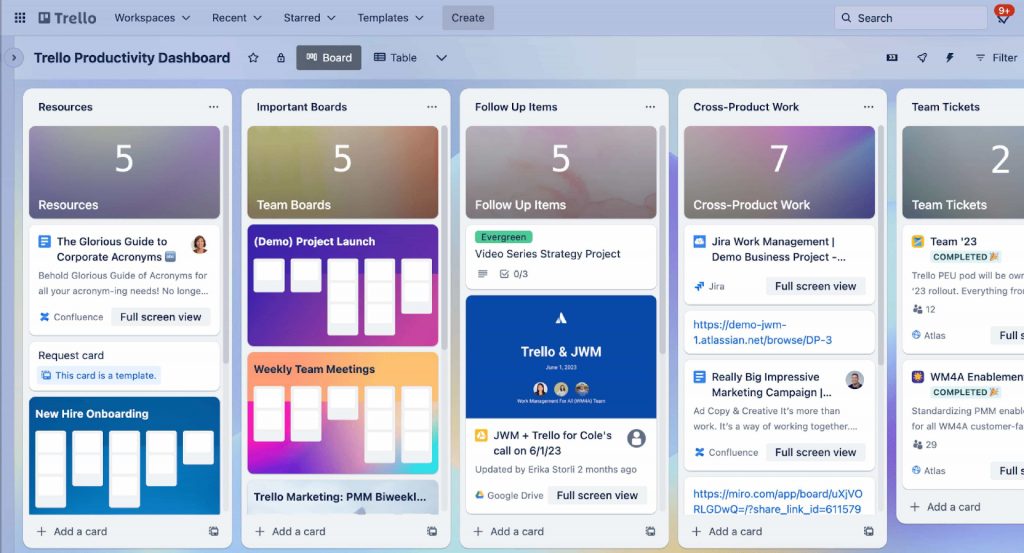
Image Source: Trello
One of the best features of Trello is its workflow automation. With Trello, you can use rule-based logic to eliminate manual processes and save time. For example, you can set up triggers, actions, and conditions to automatically move cards, send notifications, or update fields.
Also, Trello’s “Power-Ups” (third-party integrations) enhance its capabilities, allowing you to add more features such as time tracking, calendar sync, and more.
Pros:
- Customizable boards, lists, and cards to fit any workflow or project
- Butler automation bot that simplifies repetitive tasks with rule-based triggers
- Tagging and labeling options for efficient categorization of tasks
- Activity log to track project history and changes
- Search and filters to quickly find and access specific tasks or projects
Cons:
- Lack of swimlanes that makes it hard to distinguish between different types of tasks or categories on a board
- You don’t get a dashboard, table, calendar, or map view in the free plan
How Does Trello Compare to Freedcamp?
Trello and Freedcamp are both accessible, entry-level tools, but they take different approaches. Freedcamp offers a broader feature set out of the box, including task lists, milestones, and file management. Trello keeps things simpler and more visual, built entirely around Kanban boards. Freedcamp includes more project views natively; Trello locks dashboard, table, calendar, and map views behind paid plans. Where Trello pulls ahead is workflow automation: its Butler bot handles rule-based triggers that Freedcamp cannot match.
Pricing: A free plan is available with limited access to project views. Paid plans start at $5/user/month.
3. Asana – Best for Strategic Project Planning
I consider Asana one of the best Freedcamp alternatives if you are searching for strategic planning. It’s also well-known for its ability to connect work to goals.
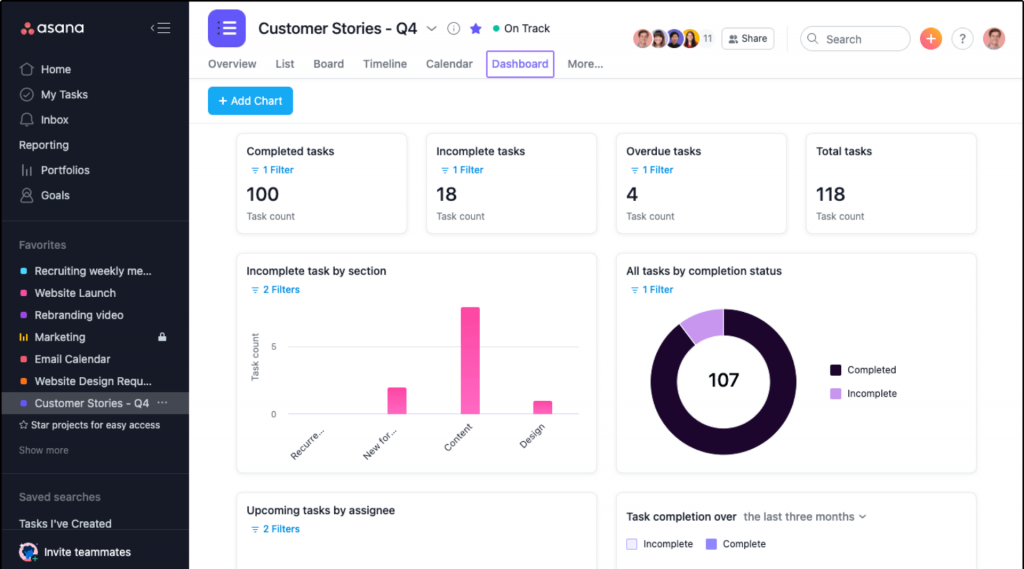
Image Source: Asana
With Asana, I can create and track company-wide, team, and individual objectives using the “Goals” feature. It helps me align my work with the strategic vision of our company. I can also see how my work contributes to the overall success of the company and measure the impact of my efforts.
For strategic project planning, the software excels in providing real-time insights and connecting work to business-critical objectives. It helps me map out the steps, milestones, and dependencies of projects using its timeline and portfolio views. You can also identify and resolve risks and blockers before they become critical issues.
Pros:
- Custom fields to add labels to tasks and sort, filter, and report on work
- Boards to organize work like sticky notes and track tasks through every stage
- Status updates that automate project reporting and keep stakeholders informed
- “My tasks” to see all assignments of team members in one place and prioritize work
- Goals and reporting to connect every team’s work to company-wide objectives
Cons:
- Asana can be slow and buggy at times, affecting the performance and user experience
- You do not get Gantt or timeline views in the free plan
How Does Asana Compare to Freedcamp?
Asana is a significant step up from Freedcamp when it comes to strategic planning. Freedcamp lacks a dedicated goals or objectives feature; Asana’s Goals functionality lets teams connect individual tasks directly to company-wide objectives, which Freedcamp cannot do. Freedcamp’s reporting is basic; Asana provides real-time insights, portfolio views, and milestone tracking that give managers much clearer visibility. Asana also has a more polished free plan with unlimited tasks and projects for small teams. The tradeoff is pricing: Asana charges per user, and Gantt and timeline views are reserved for paid tiers.
Pricing: A free plan is available with limited features. Paid options start at $10.99/user/month.
4. ClickUp – Best for Generating Detailed Reports
In my experience, ClickUp is quite similar to Freedcamp. This verdict comes from the tool’s ability to generate detailed reports with dashboards.
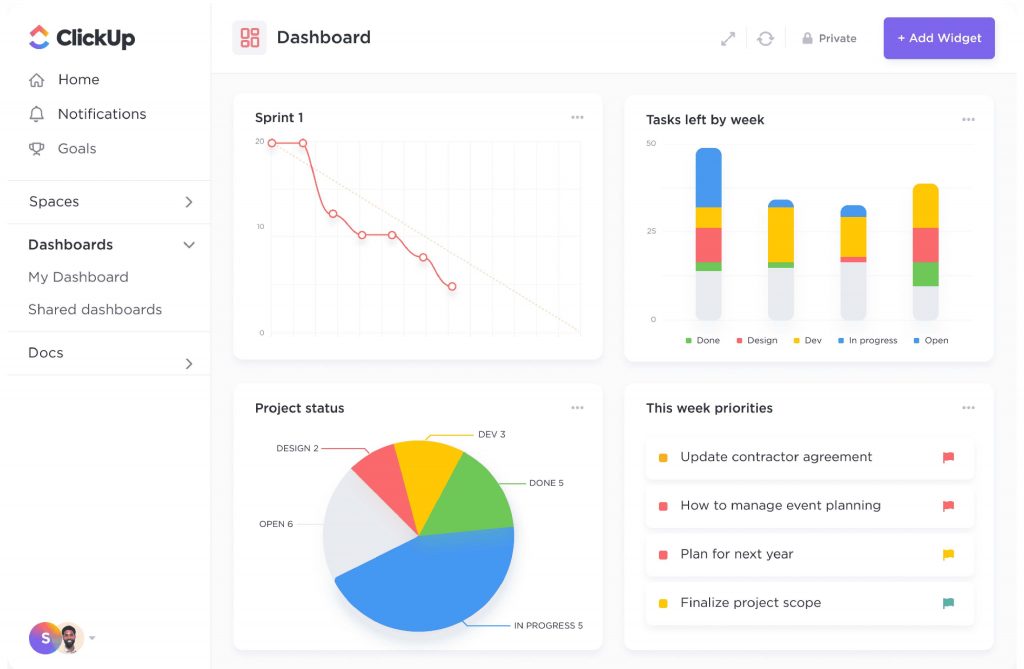
Image Source: ClickUp
The dashboards are customizable, allowing you to visualize work progress in various ways. You can choose from a glossary of widgets to build the perfect dashboard with custom charts, sprints, progress tracking, calculations, project overview, and time tracking. I found that you can also filter, share, and export dashboards to get rich insights and enhance project visibility.
Whether you are working on projects, goals, documents, or chat, you can do it all with ClickUp, a recommendation from me as a Freedcamp alternative.
Pros:
- Library of hundreds of templates for team use cases, views, tasks, checklists, docs, etc.
- Relationship feature to create the perfect visual database by linking tasks, documents, integrations, etc.
- Resource management feature that helps you balance workloads and plan sprints
- Reporting dashboard to set goals, track progress, and manage resources
- Collaboration hub to communicate with the team using comments, email, chat, etc.
Cons:
- 100 MB storage space in the free plan is not a great bargain
- The platform has a steep learning curve and can be overwhelming for new users
How Does ClickUp Compare to Freedcamp?
ClickUp covers considerably more ground than Freedcamp. Where Freedcamp offers straightforward task management and basic project views, ClickUp adds highly customizable dashboards, sprint management, a built-in document editor, and a library of templates across dozens of use cases. Freedcamp’s reporting is limited; ClickUp’s reporting suite lets you filter, share, and export dashboards with granular control. ClickUp also handles goals, chat, and documents in one workspace, reducing the need for separate tools. The tradeoff versus Freedcamp is complexity: ClickUp has a steep learning curve that Freedcamp does not.
Pricing: A free plan is available with limited storage space. Paid options start at $7/member/month.
5. Wrike – Best for Automating Administrative Workflows
If you are looking for an alternative to Freedcamp that supports administrative workflow automation, you may check out Wrike. I used the tool recently while collaborating with an industry peer for a software project.
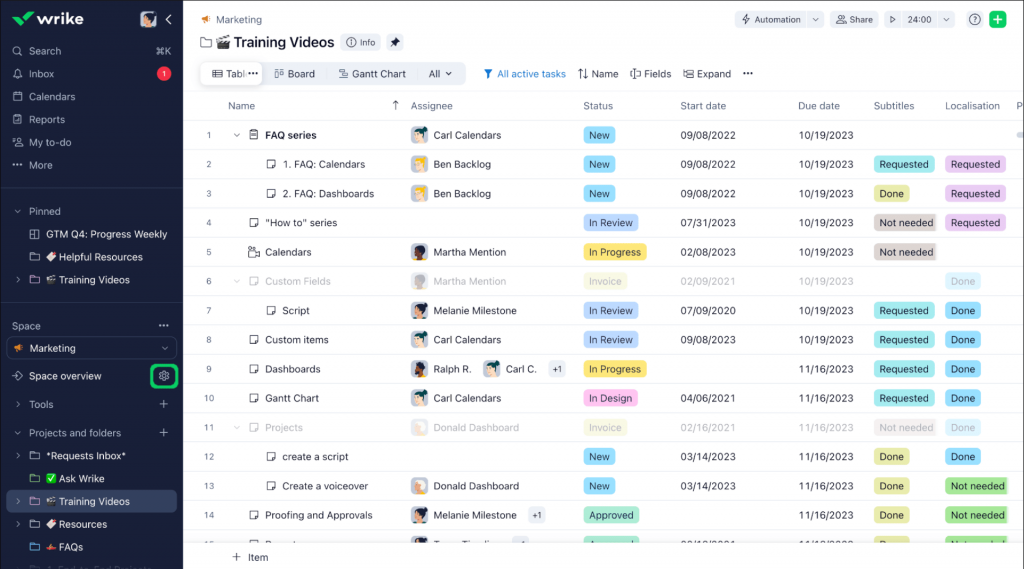
Image Source: Wrike
With Wrike, we could create automatic approvals, request forms, and repeatable blueprints to eliminate tedious and error-prone manual work. It also helped us track project progress, time, and budget with real-time dashboards.
Automating workflows enabled us to focus on delivering faster and better results.
In my opinion, Wrike can be a top recommendation from the list if you can manage its slightly heavy price tag.
Pros:
- Custom headers, fields, and workflows for different teams and departments
- Report templates, dashboards, and analytics to make data-driven decisions
- AI-powered “Work Intelligence” suite for automation, insights, and recommendations
- Supports recurring tasks, multi-day deadlines, and dependencies
- Templates and blueprints for common projects and processes
Cons:
- You don’t get calendar views, dashboards, or real-time reports in the free plan
- Doesn’t offer integrated live chat for instant communication
How Does Wrike Compare to Freedcamp?
Wrike is a more powerful tool than Freedcamp across almost every dimension. Freedcamp handles basic task management and file collaboration; Wrike goes further with automatic approvals, request forms, repeatable project blueprints, and an AI-powered Work Intelligence suite. Freedcamp’s dashboards are limited; Wrike provides real-time dashboards for tracking progress, time, and budget simultaneously. Wrike also supports recurring tasks, multi-day deadlines, and custom workflows per department, none of which Freedcamp handles natively.
Pricing: A free plan is available. Paid options start at $9.80/user/month.
6. monday.com – Best for Managing Project Resources
monday.com is an exceptional work management platform that simplifies project management. I think it’s a decent Freedcamp competitor, especially if you want an enterprise-graded tool to manage project resources.
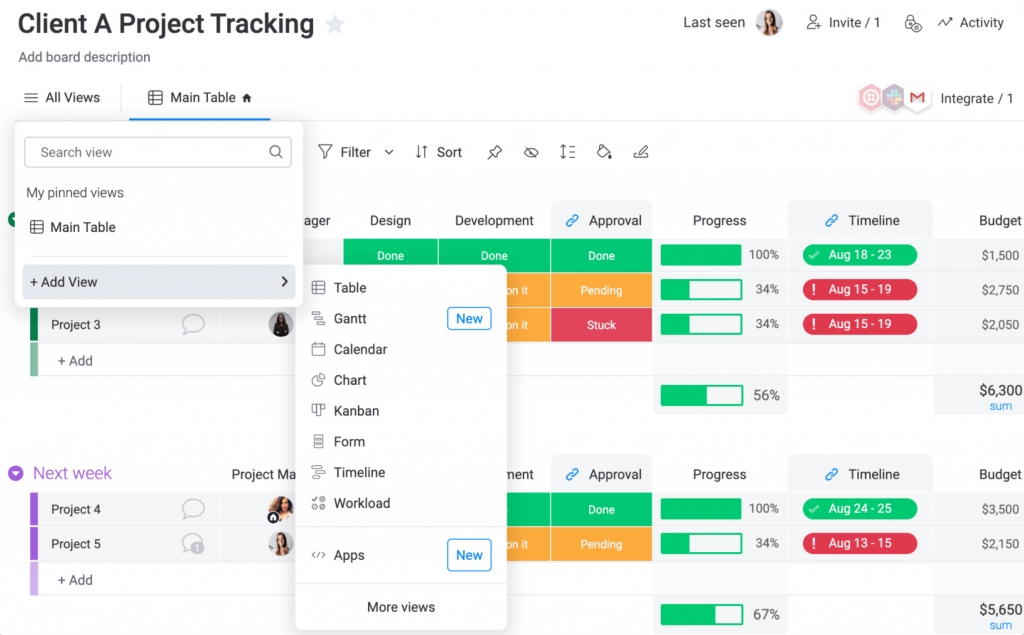
Image Source: monday.com
Using monday.com, I can easily see the workload and availability of team members and assign them to the right tasks based on requirements. I can also track the time spent on each task and manage budgets and expenses with the help of widgets and apps.
Apart from that, the software also lets you customize workflows to fit your needs. You can choose from different views, such as Kanban boards, Gantt charts, or table views, to visualize tasks.
Pros:
- Dependencies and subitems for managing complex tasks
- Agile workflows and Kanban boards for efficient task management
- Budgeting and invoicing tools for financial management
- Automation and notifications for streamlining workflows and reducing manual work
- Integrations with a ton of third-party apps, such as Gmail, Slack, Zoom, and more
Cons:
- A minimum team size of three for paid plans is a must
- Agile sprints are clunky and not well-integrated
How Does monday.com Compare to Freedcamp?
monday.com is a more polished and feature-complete tool than Freedcamp. Freedcamp’s resource management is basic; monday.com gives managers a clear view of team workload and availability, making it easy to assign the right people to the right tasks. monday.com supports Kanban boards, Gantt charts, and table views in one interface, with strong budgeting and expense tracking built in. Its automation and notification system is also more sophisticated than Freedcamp’s. The tradeoff is cost and minimum seat requirements: monday.com’s paid plans require at least three users, and its free plan is limited to two users. Freedcamp is more accessible at the entry level.
Pricing: A free plan is available for up to 2 users. Paid options start at $8/seat/month.
7. Zoho Projects – Best for Task Automation
When it comes to pricing, Zoho Projects is quite similar to Freedcamp. But is that the only reason why I included it on this list? Apparently, no.
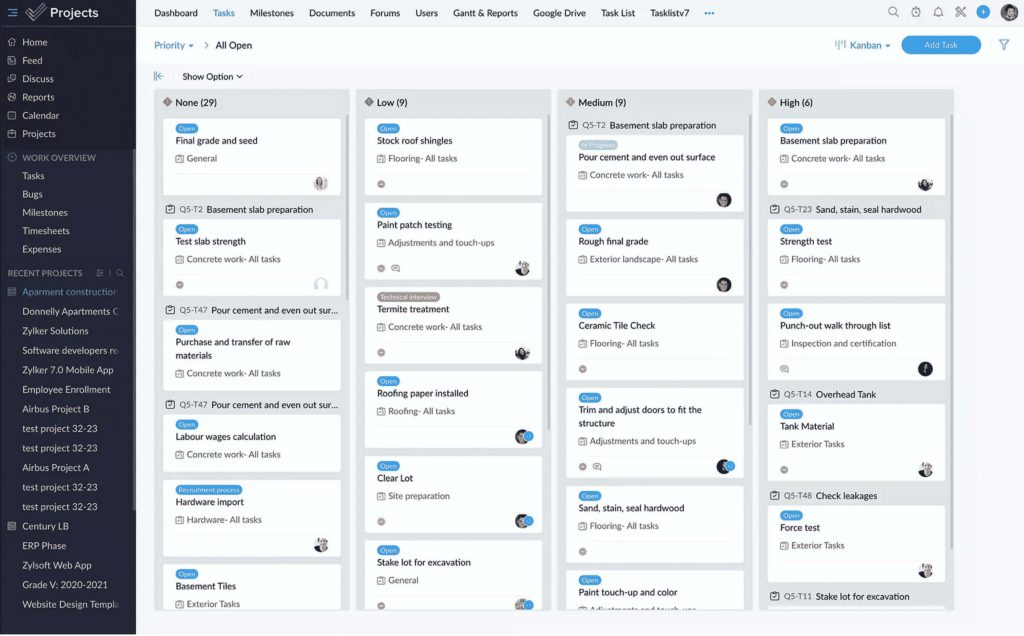
Image Source: Zoho Projects
One of the things I liked about Zoho Projects is its task automation feature. It lets me create workflows that trigger actions based on certain conditions, like setting up an automation that assigns a task to a team member and changes the status to “In Progress.” Needless to say, how time-saving this has proved.
Another thing you may like is its integration with other Zoho apps and third-party tools. I could easily sync my data and activities with Zoho CRM, Zoho Invoice, Zoho Analytics, etc. This made work seem more seamless and efficient.
Pros:
- Issue management to track and resolve bugs in software development projects
- Work breakdown structure to organize projects into milestones, task lists, tasks, and subtasks
- Different task views, including classic, plain, and Kanban, to suit different workflows
- Reminders to notify team members of upcoming deadlines and important tasks
- Project baseline to compare the planned and actual progress of a project
Cons:
- No time tracking, custom fields, project reminders, etc., in the free plan
- The reporting tools cannot withstand large teams and complex projects
How Does Zoho Projects Compare to Freedcamp?
Zoho Projects and Freedcamp are priced similarly, which makes the comparison between them more about features than cost. Zoho Projects edges ahead on task automation: its condition-based workflow triggers can automatically assign tasks, change statuses, and send reminders, which Freedcamp does not support natively. Zoho Projects also includes a dedicated issue management module for bug tracking, useful for software teams. Its integration with the wider Zoho suite, including CRM, Invoice, and Analytics, gives it a broader ecosystem than Freedcamp.
Pricing: A free plan is available for up to 2 projects. Paid options start from $4/user/month.
8. Smartsheet – Best for Real-Time Project Collaboration
Smartsheet, an alternative to Freedcamp, is designed to help teams stay on track and remain organized throughout the project management process.
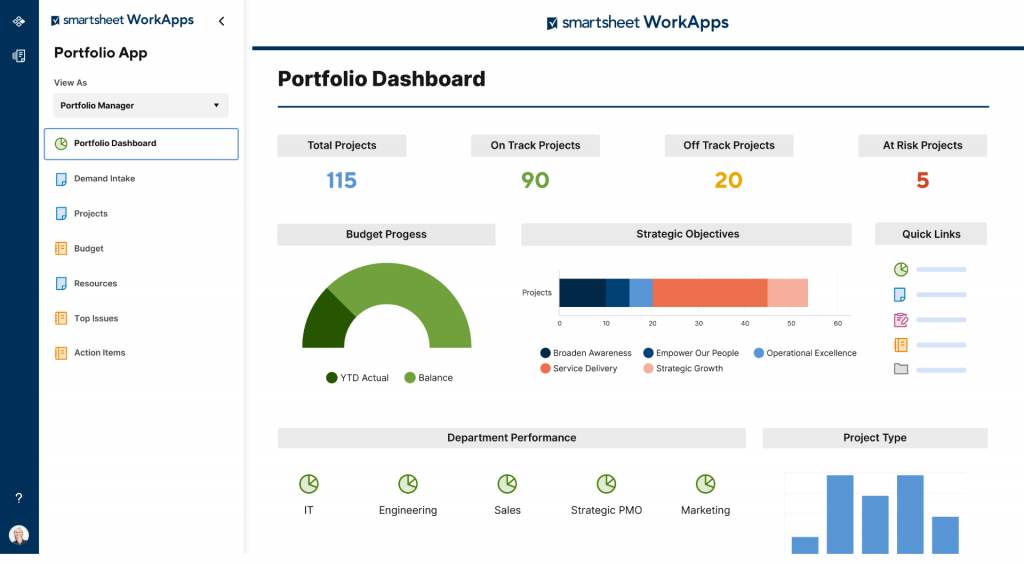
Image Source: Smartsheet
One of the best features I like is its real-time project collaboration capabilities. With Smartsheet, I can share my work with anyone, anywhere, and anytime. I can even invite collaborators to view, edit, or comment on my sheets or create forms to collect data from them. It also lets me chat with them in context or use the @mention feature to notify them of important updates.
In my time with the software, I have found it to be a great tool, especially for teams working remotely on different projects.
Pros:
- Enables team communication through commenting and alerts
- Automated report generation and scheduled delivery
- Offers resource management tools for workload planning
- Provides task dependencies and critical path highlighting
- Integrates with Google Drive, Salesforce, JIRA, and other apps
Cons:
- Only 500 MB of attachment storage in the free plan
- The software lacks task dependencies in some views
How Does Smartsheet Compare to Freedcamp?
Smartsheet is meaningfully stronger than Freedcamp for remote teams and complex collaboration. Freedcamp handles basic file sharing and task management; Smartsheet adds real-time co-editing, form-based data collection, automated report generation with scheduled delivery, and critical path highlighting for task dependencies. Its integrations with Google Drive, Salesforce, and Jira are more robust than what Freedcamp offers. Smartsheet also gives teams a spreadsheet-style layout that is familiar to users migrating from Excel, which can ease adoption.
Pricing: A free plan is available with limitations in tracking. Paid options start at $7/user/month.
9. Teamwork.com – Best for Client Management
If you’re hunting for Freedcamp alternatives that excel in client management, you may want to check out Teamwork.com.
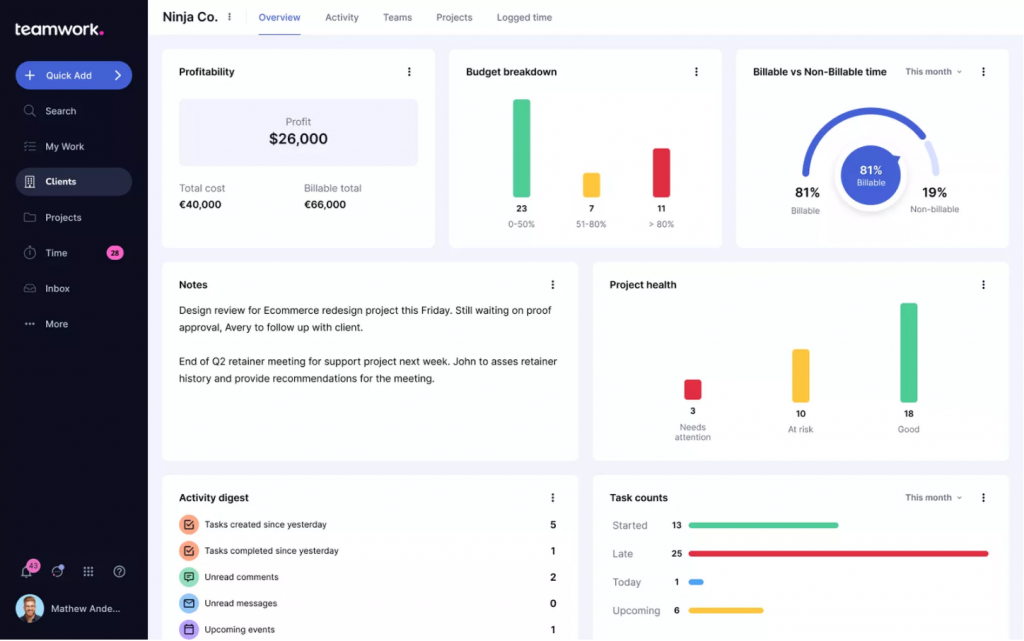
Image Source: Teamwork.com
With Teamwork.com, you can easily communicate with clients, share project updates, get feedback, and resolve issues. You can also give clients access to a dedicated client view, where they can see the progress of their projects, tasks, and milestones without exposing sensitive information or internal details.
I believe it’s an excellent way to build trust and transparency with clients and ensure maximum satisfaction. The platform also lets you plan projects, allocate resources, and optimize capacity to balance workloads efficiently.
Pros:
- Milestones to set goals and checkpoints within a project
- Intake forms to gather requests and feedback from clients and team members
- Time tracking to log time, create timesheets, and mark time as billable
- Invoices to create and export invoices based on billable hours and expenses
- Retainers to manage long-term client work and balance budget fluctuations
Cons:
- Inconsistent and unreliable API to connect with external data sources
- No resource management, custom reports, dashboards, etc., in the free plan
How Does Teamwork.com Compare to Freedcamp?
Teamwork.com is built for a use case that Freedcamp does not address well: managing projects for external clients. Freedcamp’s guest and client access is restricted; Teamwork.com gives clients a dedicated portal view showing project progress, tasks, and milestones without exposing internal details. Freedcamp has no retainer management; Teamwork.com handles long-term client billing natively. Time tracking, invoicing, and intake forms for gathering client requests are all included in Teamwork.com’s paid plans. For freelancers and agencies managing multiple clients simultaneously, Teamwork.com solves problems that Freedcamp simply cannot.
Pricing: A free plan is available for only up to 5 users. Paid options start from $5.99/user/month.
10. Podio – Best for Project Data Visualization
Podio is quite similar to Freedcamp but better when it comes to project data visualizations. Regardless of project size, I can easily visualize project components through a variety of overviews and create reports that keep me well informed.
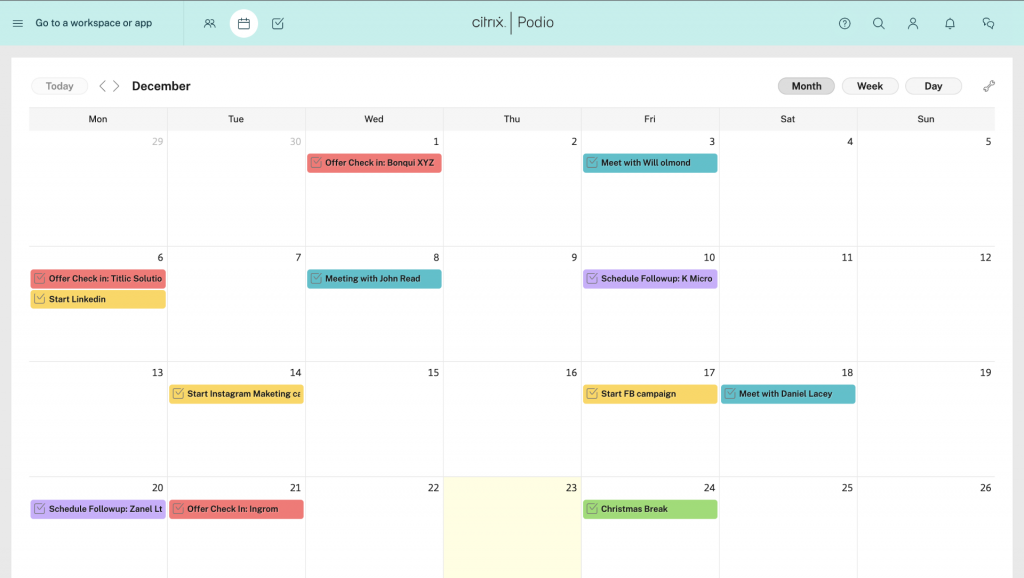
Image Source: G2
The software lets me create and share interactive dashboards that show the progress and performance of my projects. I can choose from different types of charts, graphs, and maps to display data in an engaging and concise way. I can filter, sort, and group data by different criteria and drill down into the details.
In my opinion, Podio makes it easy to see the big picture and scale the small details of projects at a glance, if you’re okay with the price tag.
Pros:
- Action-oriented overviews and advanced reporting capabilities for better decision-making
- Lets you define clear roles and permissions for different users and teams
- Enables communication within workspaces, reducing internal email
- Extensions and add-ons for specific use cases
- Integration with various tools such as Dropbox, Google Drive, and more
Cons:
- Customer support is slow, and the documentation is not very helpful
- You don’t get visual reports or workflow automation in the free plan
How Does Podio Compare to Freedcamp?
Podio and Freedcamp are similar in scope, but Podio edges ahead on data visualization. Where Freedcamp’s reporting is limited and difficult to customize, Podio lets you build interactive dashboards with charts, graphs, and maps that you can filter, sort, and drill into. Podio also supports custom roles and permissions across workspaces, giving managers more control over who sees what. Its in-workspace communication reduces email, which Freedcamp handles less elegantly. The limitations are that Podio’s free plan caps at five employees, and both workflow automation and visual reports require a paid tier.
Pricing: A free plan is available for only 5 employees. Paid options start from $11.20/month.
How Did I Evaluate These Freedcamp Alternatives?
The evaluation of products or tools chosen for this article follows an unbiased, systematic approach that ensures a fair, insightful, and well-rounded review. Over the years, I have tested dozens of project management tools across different team sizes and industries. My evaluation methodology for this list combines six factors:
- User Reviews and Ratings: I start with what real users say on platforms like G2, Capterra, and Trustpilot. Patterns in reviews, both positive and negative, tell me what the marketing copy won’t.
- Essential Features and Functionality: I look at whether the core features actually work as advertised. A tool can list Gantt charts as a feature; whether they are usable without a tutorial is a different question.
- Ease of Use: I pay close attention to how long it takes a new user to get productive. An overly complex interface is a real cost that shows up in adoption rates, not just onboarding time.
- Customer Support: I assess how well support holds up during setup, during issues, and during scaling. Slow or unhelpful support at a critical moment can derail a team’s entire adoption.
- Value for Money: I compare price against actual feature delivery, not feature lists. A $4/user/month tool that hides core features behind higher tiers is not necessarily cheaper than a flat-rate tool.
- Personal Experience and Expert Opinion: Where I have tested a tool firsthand or collaborated with teams that use it daily, I draw on that directly. Experience cuts through surface-level comparisons.
Regardless of which tool you choose from this list, always test it on a real, live project before committing. A free trial or free plan gives you ground-truth data that no review can replicate.
My Top 3 Picks for the Best Freedcamp Alternative
Choosing the best Freedcamp alternative depends on your company’s requirements. I can, however, help you by shortlisting the three best tools from the list:
1. ProProfs Project
ProProfs Project is a top Freedcamp competitor. With a simple interface, advanced features like portfolio management, budget tracking, and team collaboration tools like @mentions and file sharing, it is perfect for freelancers, startups, and SMBs.
2. Asana
Asana is a premier alternative to Freedcamp, excelling in strategic planning by seamlessly aligning work with goals. Its “Goals” feature tracks company-wide objectives, ensuring strategic alignment while providing real-time insights for effective project planning.
3. Smartsheet
Smartsheet, a Freedcamp alternative, stands out for keeping teams organized during project management. Its real-time collaboration features, such as sharing work seamlessly and chatting with collaborators, make it an excellent tool, particularly for remote teams handling various projects.
What Problems Do Freedcamp Alternatives Solve?
Most teams searching for Freedcamp alternatives are hitting one or more of these specific walls:
| Problems With Freedcamp | What Alternatives Fix |
| Per-user pricing adds up fast for client-facing teams | Flat-rate plans with unlimited users |
| No built-in invoicing or billing workflows | Native invoice generation and payment reminders |
| Limited reporting depth for growing portfolios | Custom dashboards, Gantt charts, and advanced analytics |
| Guest/client access is restricted | Dedicated client portals and free guest seats |
| No portfolio-level project overview | Portfolio management across multiple projects |
| Time tracking is a paid add-on, not native | Integrated time tracking at task and project level |
Who Should Switch From Freedcamp? (Use-Case Breakdown)
Not every team hits the same wall with Freedcamp. The right alternative depends on what is actually slowing you down. Here is a breakdown of the most common situations I see, and which tools tend to work best for each.
1. Spreadsheet Refugees Moving to a Real PM Tool
If your team currently tracks projects in Excel or Google Sheets, Freedcamp is a step up, but tools like ProProfs Project or Trello will serve you better. They offer visual task boards, due date tracking, and team accountability without a steep learning curve.
2. Agencies and Consulting Teams Managing External Clients
Per-seat pricing is a dealbreaker when you need to give clients project visibility. Teamwork.com and ProProfs Project both allow client or guest access without the seat cost ballooning. Teamwork.com specifically excels at client portals and retainer management.
3. IT and Software Development Teams
Teams coming from Jira who want lower cost should evaluate ClickUp (sprint and agile workflows) or Zoho Projects (Jira-like structure at a fraction of the price). Both support webhooks, custom fields, and integrations. You can read more about why IT teams use project management software and what to look for when switching.
4. Marketing Teams Juggling Campaigns and Collateral
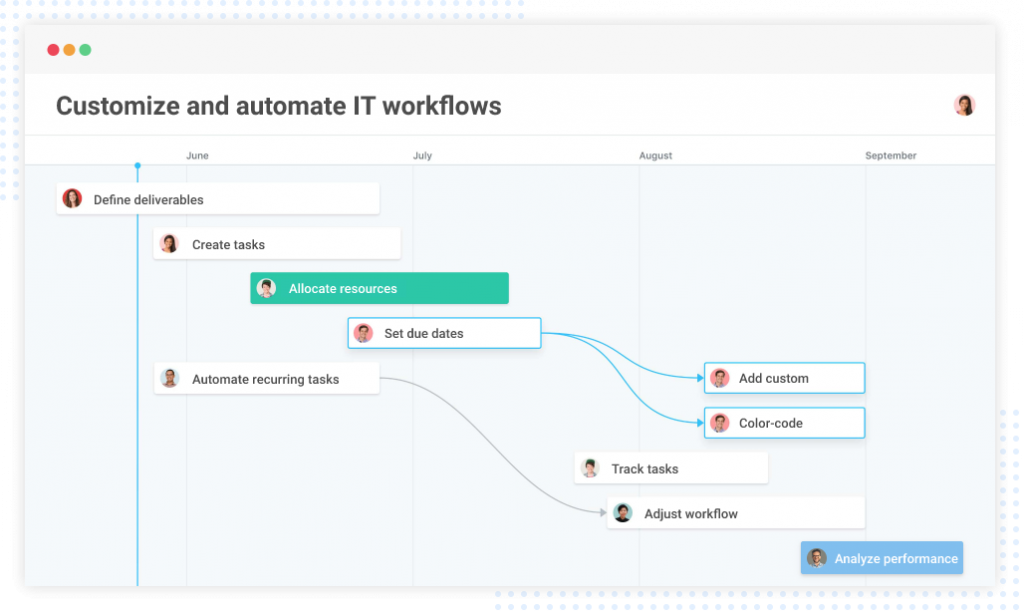
Marketing teams managing campaigns alongside ad-hoc requests benefit most from tools with strong request intake and workload management. Asana and monday.com both support these workflows with automation and role-based visibility.
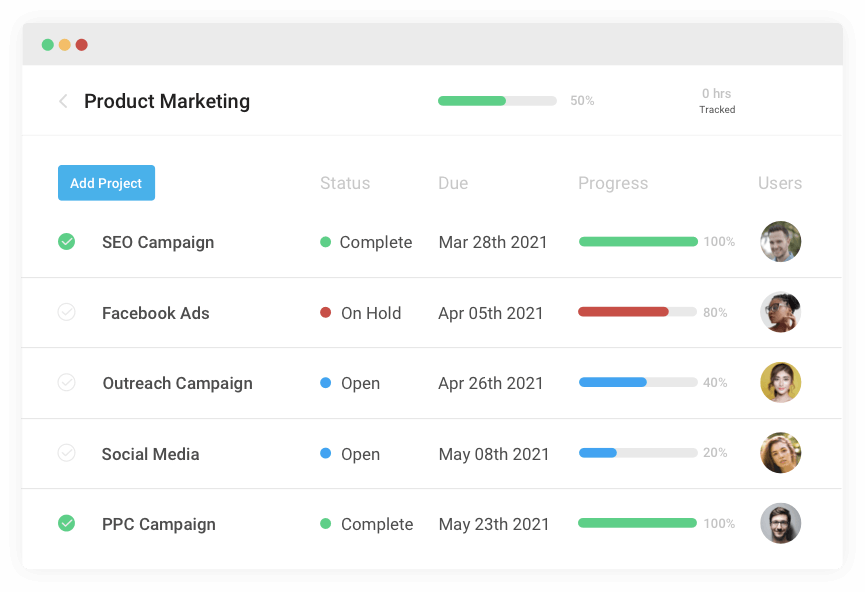
For a deeper look at this, see our guide on marketing project management.
5. Small Business Owners Scaling to Subcontractors
If you are transitioning from doing the work yourself to managing a team of contractors, you need a central hub with clear task ownership, file sharing, and budgeting. A good starting point is understanding project management in small business before picking a tool.
According to a study by the Project Management Institute in 2024, organizations that undervalue project management report an average of 67% more project failures. Teams using dedicated PM software, rather than spreadsheets or chat, complete 28% more projects on time and on budget.
Find the Right Freedcamp Alternative and Take Back Control of Your Projects
The right project management tool does not just keep tasks organized. It changes how your team communicates, how clearly work gets prioritized, and how confident you feel about where every project stands at any given moment.
The tools on this list cover a wide range of team sizes, budgets, and working styles. Whether you are running a two-person agency, managing a 50-person IT team, or somewhere in between, there is a Freedcamp alternative here that will fit better than what you have now. The key is to match the tool to your actual workflow, not the other way around.
If you are not sure where to start, I’d suggest trying a tool that keeps things simple without sacrificing the features you need as you grow. For most small and mid-sized teams, that means looking for flat-rate pricing, native time tracking, and invoicing in one place. ProProfs Project ticks those boxes and is worth adding to your shortlist.
Frequently Asked Questions
What is the best free alternative to Freedcamp?
ProProfs Project, Trello and Asana offer free plans with usable core features. ProProfs Project is better for visual Kanban workflows. Asana's free plan supports unlimited tasks and projects for up to 10 users. If you need invoicing or time tracking on a free plan, the options narrow significantly as most tools lock those features behind paid tiers.
Which Freedcamp alternative is best for small businesses?
For most small businesses, the deciding factor is pricing predictability. A flat-rate tool that does not charge per seat keeps costs stable as you hire or bring on contractors. Look for a tool that includes time tracking and invoicing natively so you are not paying for separate software as you grow.
Does any Freedcamp alternative offer unlimited users?
Yes. Some tools on this list charge a flat monthly rate regardless of team size, making them a better fit for teams that regularly add collaborators, clients, or contractors. Most alternatives charge per seat, so it is worth doing the math for your current and projected headcount before committing.
Which Freedcamp alternative is best for time tracking and invoicing?
The strongest options are tools that include both natively in a single plan, rather than requiring a paid add-on or third-party integration. Teamwork.com is strong on the full billing side including retainer management. For teams that want time tracking and invoicing without a complex setup, look for tools where both are built into the base plan. You can learn more about what to look for in our guide toproject management with invoicing.
Which Freedcamp alternative has the best Gantt chart and Kanban support?
Several tools on this list include both Gantt charts and Kanban boards natively. Trello is primarily Kanban-focused, with Gantt available only through a Power-Up. ClickUp supports both but has a steeper learning curve. For a deeper comparison of these two views, see our guide onGantt chart vs Kanban.
Is there a Freedcamp alternative built for agencies managing client projects?
Teamwork.com is built specifically for client-facing project management, with dedicated client portals, intake forms, retainer management, and billing. It is the strongest option on this list for agencies with complex client billing requirements. For teams that want simpler client access combined with flat-rate pricing, there are alternatives that cover guest visibility and invoicing without a dedicated agency feature set.
How do I migrate from Freedcamp to a new project management tool?
Most tools on this list support CSV import for tasks, projects, and milestones. Start by exporting your Freedcamp data in CSV format. Then import into your chosen tool, map fields manually as needed, and run both platforms in parallel for one to two weeks before full cutover. ClickUp and Asana both have documented import flows that are worth reviewing before you start.
FREE. All Features. FOREVER!
Try our Forever FREE account with all premium features!